Medieval WisdomBuild It Yourself · Complete $67

The frost isn’t the enemy. Standing water is.

Your foundation is already losing to water.
The videos never finish the how.

Fourteen medieval techniques taken to real dimensions, modern materials, safety and code — so you can build it this season, not just watch it.

Instant PDF. No account. 30-day refund. The $37 book is PDF-only, on the pricing page.

OUT
NOW
Medieval Wisdom: Build It Yourself — the complete guide
146K subscribers·14 techniques, A-to-Z·107 pages·methods that stood 800+ years·self-healing Roman concrete·real ratios, sourcing & code·instant PDF·lifetime updates free·30-day refund· 146K subscribers·14 techniques, A-to-Z·107 pages·methods that stood 800+ years·self-healing Roman concrete·real ratios, sourcing & code·instant PDF·lifetime updates free·30-day refund·

The trap

Every video ends the same way: "incredible… but you never show how."

The what and the why are all over YouTube. The how — the ratios, the depths, the modern material you can buy in 2026, the safety, the code — almost nobody finishes. So you watch, you get inspired, and you're left doing the research yourself.

"It's just an interesting tale in my books."

You wanted a blueprint. You got a documentary.

"I plan on building my house this way. I had to do the research myself."

The knowledge exists — scattered across papers, codes, and comment sections.

"Show me how these work in real freeze/thaw climates."

Most "ancient building" content quietly only works where winters are mild.

The idea that makes it work

The history is free. The buildable version is the work.
We call it the Buildability Layer.

Every chapter takes a technique through three layers — the same three the videos stop after layer one.

The mechanism

Why it actually works — the real enemy (usually water, not cold; heat, not air) — so you can adapt it to your site instead of copying blindly.

The questions you asked

The exact "but how do I…" from thousands of comments — quantities, modern substitutes, where to buy, what climate it's for.

The researched build

Real proportions, sourcing, tools, the step sequence, the safety, and how it maps to the building code — each pass cross-checked against the record.

Not a description — a real page

This is what "buildable" looks like

Chapter III · Foundations
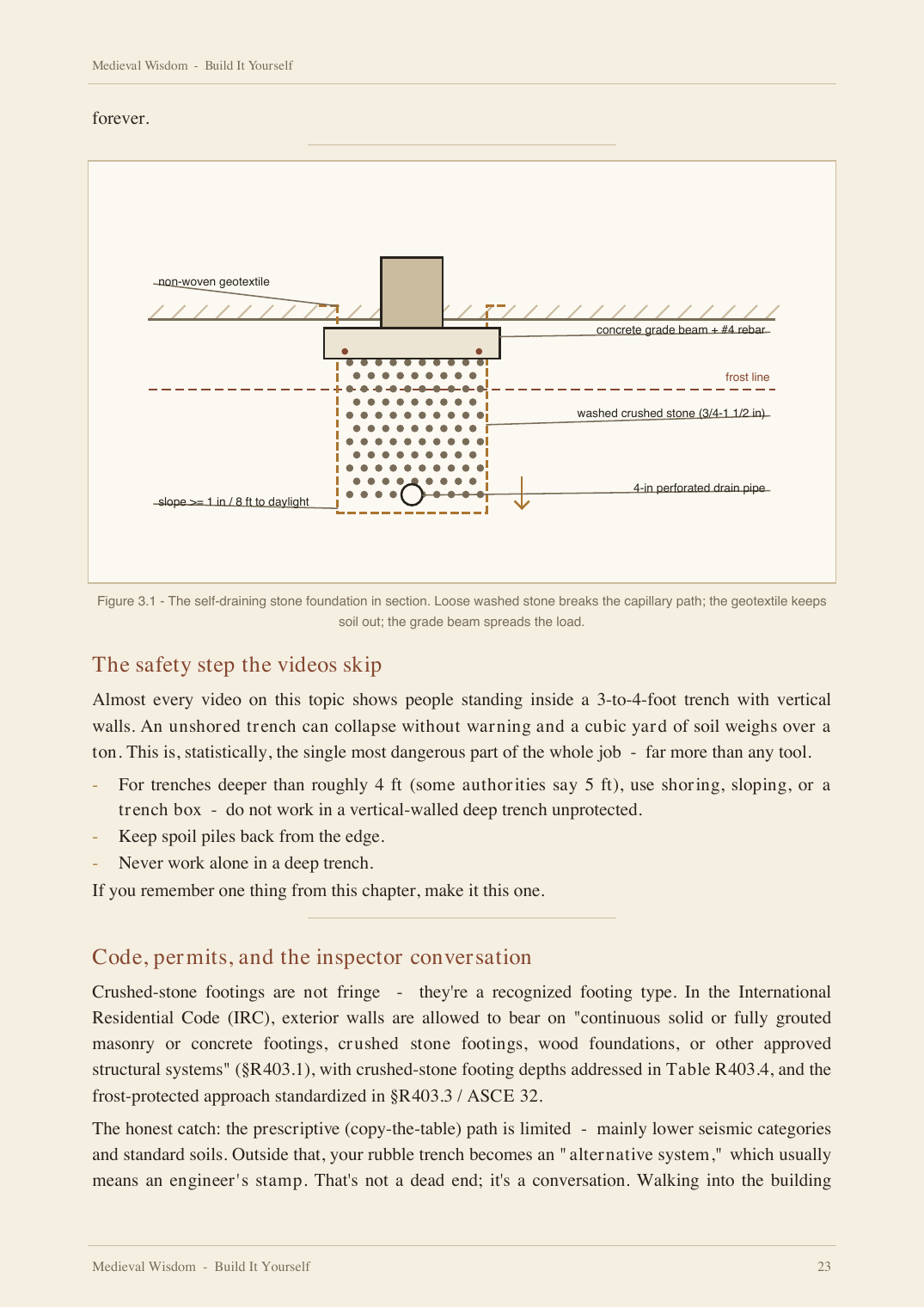
The self-draining stone foundation

Representative build spec (final numbers keyed to your local frost line + soil):

Trench width18–24 in
Depthbelow frost line (12–48 in)
Floor slope to outlet≥ 1 in / 8 ft
Washed stone¾–1½ in, angular
Compaction lifts~8 in
Grade beam8–12 in W × 6–8 in D, #4 rebar
Safety: trenches over ~4 ft can collapse without warning — shore, slope, or box them. The one step the videos skip.
Code reality: a recognized footing under IRC R403.1 / Table R403.4; outside the prescriptive path you'll want an engineer's stamp — the chapter shows how.
Page 23 of the book: the rubble-trench cutaway diagram, the trench-collapse safety panel, and the IRC code section
Page 23, unretouched — the cutaway, the safety panel, the code section

What's inside

Fourteen builds — each one a result you can reach

Not a syllabus of topics. Each chapter names what you'll be able to build, who it's for, and roughly what it takes.

I · Roman concrete & lime
1
Concrete that heals its own cracksthe hot-mix method rediscovered by MIT in 2023, with modern materials and the safety around caustic lime.
Garden-scale · intermediate
2
$3 waterproofing that lasts centuriesthe crushed-terracotta trick, and the one firing-temperature test that tells you if your material will work.
Low-cost · beginner
II · Foundations
3
A footing that drains itself and never heavesfor anyone on a sloped or wet lot.
Core skill · weekend
4
Footings on bedrock + mortar that breatheswhy lime outlives Portland, and when to use which.
Intermediate
III · Walls
5
The rubble-core walltwo faces, a stitched core, built to stand for centuries.
Advanced
6
Rammed earththe mix, the forms, and the timber frame it must work with.
Advanced · seismic notes
7
Walls that breathewattle-and-daub, cob, and lime, and where each belongs.
Beginner-friendly
IV · Shelter
8
Dig down to stay warmthe dugout / Grubenhaus, for a root cellar or a winter dwelling.
Weekend · earthworks
9
The corbelled dry-stone huta roof of stacked stone, no mortar, no timber.
Advanced · patient
V · Heat
10
A masonry stove still warm at dawnthe Russian pech that holds a single fire's heat all night.
Advanced · CO safety
11
The Rumford fireplacethe geometry that actually throws heat into the room.
Intermediate
12
The physics enginethermal mass, stack effect, and draft — the sizing math behind chapters 10–11.
Reference
VI · Fuel
13
Firewood dry months soonerthe attached lean-to that does the real work (we're honest about which claims are disputed).
Beginner · weekend
14
Cut it rightstanding-dead seasoning, kerfing, and species timing.
Beginner

The shift

Stop collecting interesting tales

Before
  • Watching, inspired, then stuck
  • Doing the research yourself, alone
  • Guessing whether a method fits your climate
  • Depending on a contractor for everything
After
  • Pour a footing that drains itself
  • Raise a wall that breathes and lasts
  • Build a stove that's still warm at dawn
  • Know exactly where to stop and call an engineer

The kind of self-reliant know-how you can use on your own land — and hand to your kids.

The math

What these decisions actually cost

One method you get right — or one mistake you don't make — is worth many times the price of the book.

A contractor's frost-depth footing$4,000–$15,000
Fixing a foundation that heaved$1,500–$10,000
A structural engineer's afternoon$300–$800
The comparable underground-house book readers cite$50+
The Complete kit — all 14, plus the pages you take to the job$67

Costs vary by region and project. This isn't a savings guarantee — it's the price of the decisions the book helps you make.

Straight from the audience

We didn't write these. You did.

Real, unedited comments from the channel — the exact reactions that shaped this book. Typos left in on purpose.

"I really want to try this. I want to make a small, deeper one to serve as a root cellar and maybe later make a bigger one as a winter dwelling. It will be in the Scottish highlands…"

— a subscriber, on the dugout video

"I grew up helping my grandfather build 'dry' stone walls… when I go back to visit, 50 years later 2 of them are still in place."

— a subscriber, on the dry-stone video

"They only show buildings in areas that do not have bitterly cold winters… Please talk about how these techniques work in areas with real freeze/thaw cycles."

— a subscriber (the objection this book answers)

"Stunning knowledge. Inspiring and empowering technology. Is there maybe a book in the making?"

— a subscriber

"I only know about it because I plan on building my house this way. I had to do the research myself of course."

— a subscriber

"Vitruvius' recipe… a 1:3 ratio of lime to volcanic ash. For underwater structures, a 1:2 ratio, which cures in water, forming incredibly durable, self-healing structures."

— a subscriber (they want the exact recipe — so we give it)
No star ratings yet. We just opened the doors, and we won't paste a fake "4.9 ★" on the wall. From 1,912 comments we mined, the single loudest request was to actually show the build — so that's exactly what this is.
Medieval Wisdom

Who's doing the work

From the Medieval Wisdom channel — 146K subscribers, and counting.

Every chapter is built from a specific video in the archive, then taken further: a dedicated research pass adds the quantities, modern materials, safety, and code — cross-checked against the record (the MIT/Nature work on Roman concrete, the IRC on footings, Vitruvius on the originals). Where a popular claim is disputed, we say so instead of repeating it. That honesty is the whole point of a build book: get it wrong and someone gets hurt.

One kit for the job. A PDF if you only want to read.

Most people take Complete.

Same 14 techniques. The $37 book is the PDF at the desk. Complete is the pages you carry to the supplier and the trench. Lifetime updates free.

The book

PDF at the desk. No job-site files.

$37USD

107-page PDF · 14 chapters

  • All 14 chapters, A-to-Z buildable — 12 cutaway diagrams
  • Real quantities, modern materials, safety & code notes
  • No printable worksheets
  • No regional sourcing pack
  • Instant PDF · lifetime updates · 30-day refund
Get the PDF · $37
Worksheets & sourcing can be added at checkout ($24)
Best for the workshop

Complete

The book, plus the two things you take to the job.

$67USD

The delivery that matches how the work actually happens

  • Everything in the book — all 14 chapters, 107 pages
  • Printable worksheets — spec cards, safety checklists, bills of materials, test logs
  • Regional sourcing pack — where to buy lime, pozzolan, firebrick & drainage in the US, UK, EU and Australia
  • Instant PDF · print it · lifetime updates · 30-day refund
The 14-chapter book$37
Worksheets for all 14 builds$19
Regional sourcing pack$19
Together$75 → $67
Get the Complete kit · $67

Instant PDF. No account. 30-day refund.

Secure checkout · cards or PayPal
VISAMASTERCARDAMEXPAYPAL

Buying the book first? Gumroad will offer the worksheets and sourcing pack before you pay — $24 instead of $30. Same files as Complete.

30-DAY
REFUND

Read it, price a wall, walk your site.

If it's still just an interesting tale to you, email within 30 days for a full refund — and keep every file you've downloaded. Less than one contractor's site visit, and the risk sits with us.

Reply to your receipt — no forms, no questions.

Straight answers

Questions

What exactly do I get?
The $37 book is the 107-page PDF: all fourteen techniques, each taken to real dimensions, modern materials, tools, the step sequence, safety, and code. Complete ($67) adds printable worksheets for every build and a regional sourcing pack — the pages you take to the supplier and the site. If you start with the book, you can add those two files at checkout for $24. Delivered instantly; lifetime updates free.
Will these methods work in my climate?
That's exactly what the book is for. It gives you the frost-line and site logic to adapt to your conditions — and it's honest about where a method is the wrong choice (expansive clay, high-seismic). Its job is to help you pick the right method for your site, not pretend every method fits everywhere.
I'm not a professional builder.
Neither were the people who built this way for centuries. Chapters assume no trade background and flag exactly where to bring in an engineer or inspector.
What format is it? Can I print it?
A clean, illustrated PDF you can read on any phone, tablet, or computer — or print for the workshop. Yours to keep.
How do I get it? Do I need an account?
Pay, and an email with your download arrives instantly. Guest checkout — no account to create. Cards or PayPal.
Why pay when the history is free online?
The history is free. The buildable version — ratios, sourcing, safety, code, across 14 techniques with modern materials — isn't. A single-method book won't cover your foundation, your wall, and your stove. That's the work you're paying for.
What if it's not for me?
Reply to your receipt within 30 days — no forms, no questions — and you're refunded. Keep every file you've downloaded.

One decision left

Start building, not just watching.

Fourteen techniques. The kit you carry to the job.

Instant PDF. No account. 30-day refund.

Not ready?

Read the foundation chapter free.

The complete self-draining stone foundation — A-to-Z. No email. Decide for yourself.

Read chapter 3

Free PDF. No form.